
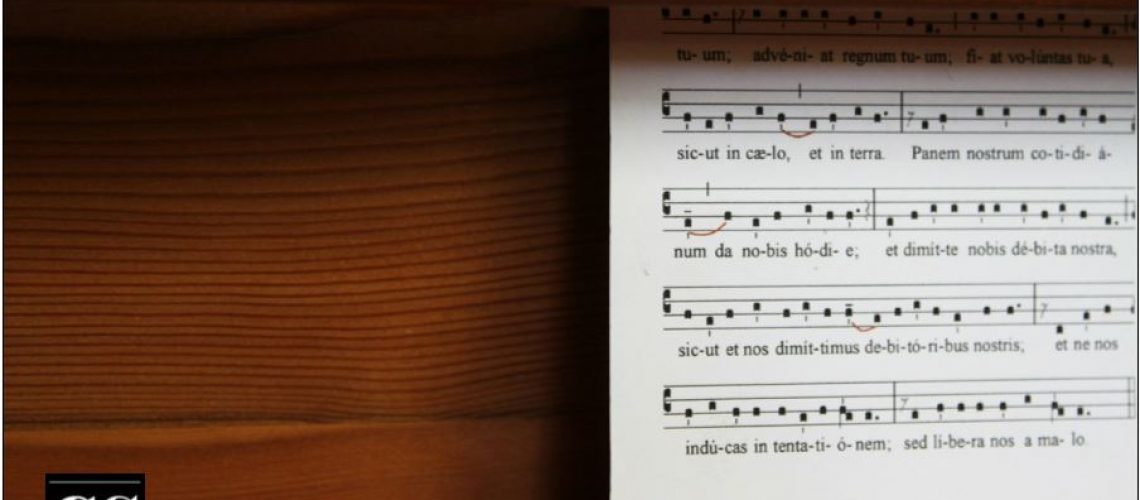
“Sing unto the LORD with the harp; with the harp, and the voice of a psalm. With trumpets and sound of cornet make a joyful noise before the LORD, the King.” Psalm 98:5,6 (KJV)
INTRODUCTION: LITURGY MADE POWERFUL BY MUSIC
During these trying times, one of the things I’ve missed most is liturgical music, the hymns and chants that are an integral part of the Mass. My road to spiritual communion has very often been paved with melody and words. For example, 25 ago when I was a catechumen (at the ripe age of 65), I had a hard time believing in the dogma of transusbstantion. that the host was truly changed into the body and blood of our Lord.
That changed during a 40 Hours devotional service. (See Top Down to Jesus.) As the monstrance was carried in during the procession, Pange Lingua was played, and I read in the missal “Præstet fides supplementum, Sensuum defectui.” Enough of my high school Latin came back, “faith will supplement the deficiency of the senses,” and I realized in my heart that the wafer, the host, was the body of Christ, that it was mystery beyond science and philosophy, and my eyes filled with tears. I must emphasize that it was both the music and the situation that moved me.
Other liturgical music has struck to my heart in ways no homily or theological text seems to do. During my first Easter Vigil Mass The Litany of the Saints was played, and an overwhelming vision of the history of the Church and all its holy people came to me. During Vespers at St. Vincent Archabbey (attended during retreat as a Benedictine Oblate) a great peace and understanding came over me as I listened to the strong voices chanting the psalms.
MUSIC IN STREAMING MASSES
You can’t have a full choir if you enforce social distancing. The daily Mass streamed by EWTN is a semi-exception to this rule: there are usually four singers, situated behind the sanctuary and open to the camera. However, many streamed Masses have no music at all. Even at major Cathedrals, there is no choir for Sunday Mass, only a cantor.
However, I have found one treasure: not a streaming Mass, but an mp3 recording of the Sunday Mass from St. Thomas More parish of the Anglican Ordinariate Usage (with a liturgical guide). I’ve written elsewhere on the beauty of the Anglican Usage liturgy (see here and here), so I won’t repeat that discussion here. The music in the recording of the Mass for the 3rd Sunday of Easter was beautiful, even though there was no choir: a strong tenor, a clear boy soprano, an a sonorous organ, with hymns that came from the old Anglican Hymn book.
And then there is Youtube. One can go back in time and find recorded videos of the mass for the day, if not this year, with choir and congregation.
DOES MUSIC DISTRACT FROM TRUE DEVOTION?
Some Church liturgists might think that my carping about inadequate music in streaming Masses shows a lack of true devotion. Which is to say, I don’t appreciate what’s important in the liturgy; my opinions reflect a sentimental bias.
It is not surprising that Church leaders have doubted whether the feelings which music arouses are truly religious. Music’s power to fan the flames of piety may be more apparent than real… Anthony Storr, Music and the Mind
The Hebrews did not worry about music being a distraction from devotion to the Lord. David danced in the procession to the altar and the psalms say “Sing to the Lord a new song, play the lute, the lyre and the harp, sound the trumpets”. St. Augustine, entranced by music, was concerned that this power might enable the senses to overcome the intellect in worship:
“So I waver between the danger that lies in gratifying the senses and the benefits which, as I know, can accrue from singing….I am inclined to approve of the custom of singing in church, in order that by indulging the ears weaker spirits may be inspired with feelings of devotion. Yet when I find the singing itself more moving than the truth which it conveys, I confess it is a grievous sin, and at those times I would prefer not to hear the singer. (emphasis added)” St. Augustine, Confessions
I cannot subscribe to that view. I am one of St. Augustine’s weaker spirits. I believe God gave many, many gifts to man in giving him intelligence: language, mathematics, art, and most valuable, music.
Music has the power to heal the soul (as Oliver Sacks shows in Musicophilia) and to bring one closer to God. We give joy to God when we rejoice in music, not only to praise Him, but to rejoice in life (l’Chaim).
CONTEXT IS ALL
Let me add one more thought. It should be clear that it isn’t the music by itself that is moving, but the total situation: liturgy, congregation, the words, Holy Communion. I could read
“Amazing Grace, how sweet the sound,That saved a wretch like me.I once was lost but now am found,Was blind, but now I see.T’was Grace that taught my heart to fear.And Grace, my fears relieved.How precious did that Grace appearThe hour I first believed.” Liberty Lyrics John Newton
It would be moving, but it is the combination of the words that reflect my own experience AND the music that brings me to tears of joy. I could read the verses of Tantum Ergo and Pange Lingua, but it would not be meaningful without the presence of Christ’s body, the procession, the Benediction, and the congregation sharing this experience.
So let’s hope that good times will come soon, when we can immerse ourselves in the total body of worship: words, music and—the most important element of all—reception of the Eucharist.
REFERENCES:
Robert Jourdain, Music, the Brain and Ecstasy: How Music Captures Our Imagination
Oliver Sacks, Musicophilia, Tales of Music and the Brain
Anthony Storr, Music and the Mind
-
Share


It’s a shame that the parishes went back to seeing the same protestant songs during Masses. And this when Our Lord chastised us with the pandemic because we rejected the Traditions of the Church.